Hospitals & Healthcare
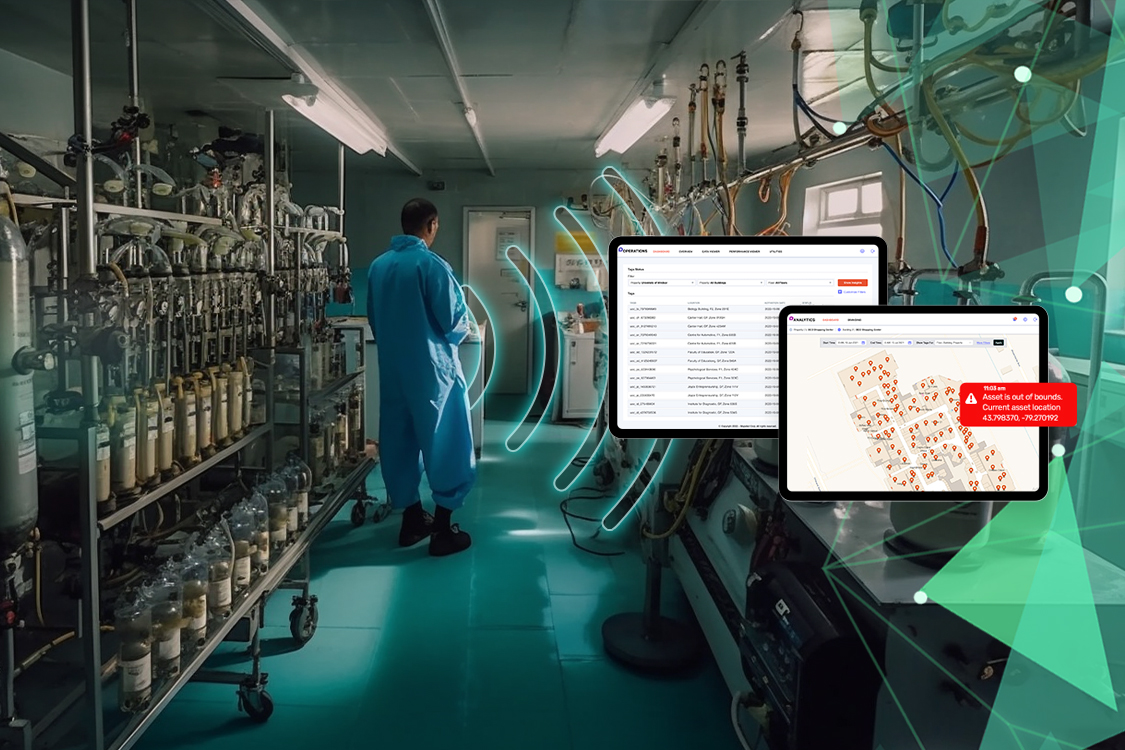
Hospital asset tracking is the practice of knowing, in real time, where mobile medical equipment is — infusion pumps, telemetry units, wheelchairs, specialty beds, ultrasound carts. Tags attached to each item report to receivers across the building, and software shows what you have, where it is, and whether it is in use. The business case is rarely theft: it is the clinical time lost to searching, and the equipment hospitals buy or rent because they cannot find what they already own.
This guide covers what the evidence shows equipment tracking delivers, how to build an ROI case that survives scrutiny, what the technology choices actually mean, and the ways these projects fail. It does not quote per-tag pricing — that depends on asset count, coverage and accuracy tier, and a number published without seeing your estate would be a guess.
What the evidence shows
Three peer-reviewed sources are worth knowing before you write a business case — including one large qualitative study whose conclusion was that asset tracking is the RTLS application that most reliably works.
- 86.8% faster equipment search and a 20.9% reduction in delivery time, with 91.2% staff satisfaction, tracking circulating beds and medical equipment in a metropolitan hospital. Huang TL et al., Int J Qual Health Care 2025;37(1)
- Mobile X-ray scheduling from 12 minutes to 5 (58.3%), with the idle rate falling from 16% to 12%, over six months in a radiology department. Tseng WC et al., Radiography 2025;31(4)
- A three-year study of 23 US hospitals with 80 interviews found that while most systems in use showed “substandard functionality”, “the current best use of RTLS is for asset tracking” — provided it is deployed hospital-wide and controlled centrally, “preferably by materials management or biomedical engineering departments”.
That last finding is the most useful sentence in the literature for anyone planning this, and it is worth reading twice. The reliable win is asset tracking. The conditions attached to it — whole-hospital and centrally owned — are the two things most commonly cut from a business case to reduce its cost.
About the “$14 billion” figure
You will meet the claim that US nurses waste $14 billion a year searching for equipment, or spend “up to 60 minutes per shift” doing it. It comes from a 2023 Georgia State University review sponsored by an RTLS vendor, and the total is an extrapolation — minutes per shift, multiplied by 1.7 million nurses, multiplied by $40 an hour — not a measured figure.
The underlying observation that nurses lose meaningful time to searching is well supported. The $14 billion headline is arithmetic on top of it. If you put that number in a board paper, expect to be asked where it came from, and have the peer-reviewed figures above ready instead.
Building an ROI case that holds up
Most asset-tracking business cases lead with theft reduction. That is usually the smallest line. The four that actually move are:
- Utilisation. The largest and most consistently underestimated. Hospitals routinely own more equipment than they can locate, so they buy or rent more. Measuring true utilisation frequently shows the fleet is adequate and badly distributed rather than too small — which converts a capital request into a redistribution exercise.
- Rental spend. Short-notice rentals are expensive and are often triggered by an item being unfindable rather than genuinely unavailable. This is the fastest line to measure, because finance already has the invoices.
- Clinical time. Search time recovered, quantified at actual staff cost. Use your own baseline, not a published average.
- Maintenance and compliance. Scheduled preventive maintenance requires locating the device. Biomedical engineering teams lose substantial time rounding up equipment for planned servicing, and missed servicing carries a regulatory cost of its own.
Measure the baseline before you buy. Without a pre-deployment number for search time, utilisation and rental spend, you will not be able to demonstrate the benefit afterwards — and the studies above show it is demonstrable when someone bothers to measure it.
What accuracy do you actually need?
This decides the cost of the whole programme, and it is usually over-specified.
| The question you are answering | Tier needed | Practical meaning |
|---|---|---|
| “How many pumps do we own and are they in use?” | Zone / floor | Cheapest infrastructure; answers most utilisation questions |
| “Which ward is this bed on?” | Zone | Room-level certainty needs a technology that respects walls |
| “Which room, definitively, for infection control?” | Room | Infrared or ultrasound contain to a room by physics |
| “Exactly where in this theatre is the tray?” | Coordinate | UWB territory; a much larger anchor commitment |
| “Did it leave the building?” | Choke point | Readers at exits only; very cheap |
Almost every equipment question is zonal. Paying for centimetre accuracy to answer “which floor is it on” is the most common way these budgets get consumed without the operational problem being solved. For accuracy figures by technology, with sources, see our RTLS guide.
What gets tracked, and what it changes
Finding equipment faster
The immediate effect, and the one staff notice. It matters most in time-critical moments — a crash cart, a specific pump size during a deterioration — where the difference is clinical rather than economic.
Preventive maintenance and downtime
Biomedical engineering can only service what it can find. Location data turns a hunt into a route, and usage data allows servicing by actual hours rather than calendar date — which both reduces unnecessary servicing and catches heavily used devices sooner.
Par levels and distribution
Once utilisation is visible by department and time of day, equipment can be positioned where demand actually is. This is usually where the recurring saving lives, and it does not require any new hardware once the system is in place.
Recalls and infection control
A manufacturer recall on a specific lot becomes a query rather than a building-wide search. The same applies to withdrawing a device from circulation for decontamination — you can prove it was removed, not assume it.
Is this “IoT asset tracking”?
Largely, yes — the terms are used interchangeably and the distinction is more marketing than engineering. “IoT asset tracking” usually describes the same thing framed around the network: tagged devices reporting over a wireless network into a platform that other systems can query.
Where the IoT framing adds something real is telemetry beyond location. A tag that also reports temperature, battery state, motion or usage hours turns an asset register into a condition-monitoring system: cold-chain compliance for a vaccine fridge, servicing scheduled by actual running hours rather than the calendar, or a device flagged as unused for 30 days and therefore a candidate for redistribution.
Two cautions. Sensors add cost and shorten battery life, so specify the telemetry you will actually act on. And a device on the hospital network is a device on the hospital network: tags and gateways belong in your security review, network segmentation plan and procurement security questionnaire alongside any other connected medical equipment.
How these projects fail
- Partial coverage. If one ward is dark, staff cannot trust the map anywhere and revert to searching. Value falls away faster than coverage does — which is precisely why the 23-hospital study specified whole-hospital deployment.
- The tag register rots. Tags come off during cleaning, equipment is retired, batteries die. Within a year an unmaintained system is confidently wrong, which is worse than being obviously absent. Name the owner of that register before go-live.
- Departmental ownership. The same study is explicit: central control, preferably materials management or biomedical engineering.
- Nothing in the workflow changes. A dashboard nobody acts on is a recurring cost with no return.
- Accuracy specified from a lab figure. A system sold on 10 cm and delivering 50 cm on a real ward has failed its promise, not physics.
Where Mapsted fits — and where it does not
Worth stating plainly, because it is the question that matters for this page. Mapsted Tag tracks equipment and inventory, and Mapsted Badge tracks personnel, with real-time location, movement history and utilisation reporting. The same technology also drives patient and visitor wayfinding from a phone.
What “hardware-free” does and does not mean. A tag goes on the pump — that is unavoidable, because an object with no radio cannot report its own position, and it is true of every system on the market. What is avoided is the anchor and beacon infrastructure normally installed throughout the building, along with its maintenance. That is the difference worth asking every vendor to quantify, because it is where installation cost and disruption live.
The honest boundary is accuracy tier, not asset type. If you need dependable centimetre-level coordinates — surgical instrument trays within a theatre, for instance — a dense UWB anchor deployment is purpose-built for that and we will say so. For the zone and room-level questions that cover most hospital equipment tracking, avoiding an estate-wide anchor installation is usually the bigger practical win. Tell us what you are trying to solve and we will tell you which tier it needs.
Frequently Asked Questions
What is hospital asset tracking?
Attaching tags to mobile medical equipment so its location and usage are visible in real time, rather than relying on manual logs or staff searching. It is typically used for infusion pumps, beds, wheelchairs, telemetry units and imaging carts.
What return do hospitals actually get?
Peer-reviewed deployments report 86.8% faster equipment searches and a 20.9% reduction in delivery time. The largest financial lines are usually improved utilisation and reduced short-notice rentals rather than theft prevention. Baseline your own numbers before deployment, because published averages will not survive a finance review.
Is hospital asset tracking the same as RTLS?
Asset tracking is one application of RTLS — and according to a study of 23 US hospitals, the one that works most reliably. RTLS also covers staff duress, patient flow, infant security and contact tracing. See RTLS in healthcare for the wider picture.
How accurate does it need to be?
Usually zone or room level. Most equipment questions — what do we have, where is it, is it in use — are answered without coordinates. Centimetre accuracy requires far more infrastructure and is justified only by specific use cases such as instrument tracking within a theatre.
Do we have to tag everything at once?
You can phase by asset class — start with the most-searched, highest-rental category — but the evidence is against phasing by geography. Partial building coverage undermines trust in the system everywhere, because staff cannot tell whether “not found” means absent or unmonitored.